
Engineering Drawing Basics Course in Phagwara
Learn Engineering Drawing Basics in Phagwara at Techcadd. Develop skills in technical drawing, dimensioning, projections, scales and geometric construction.
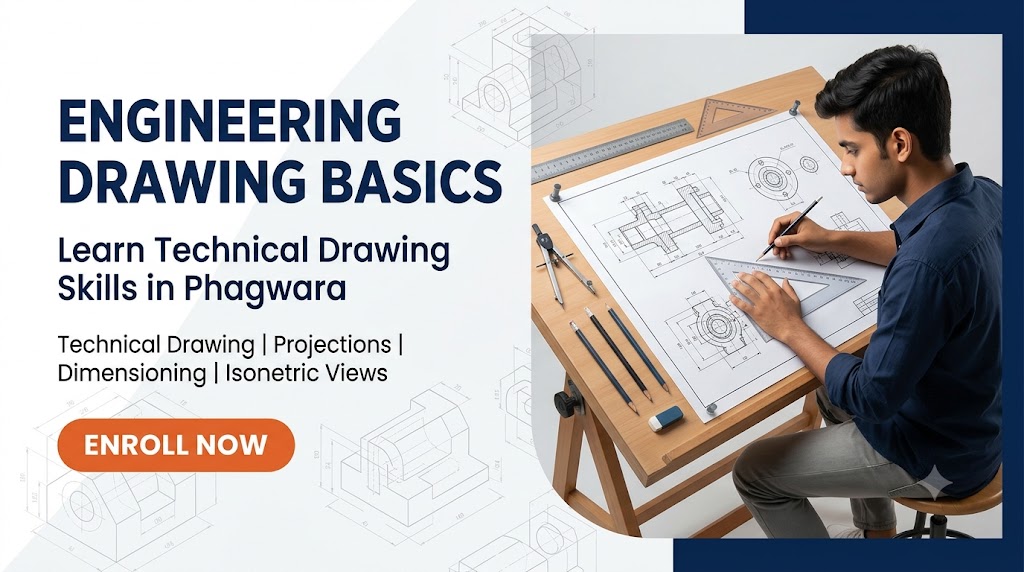
Introduction to Engineering Drawing Basics
Engineering drawing is an important skill used in engineering, architecture, mechanical design, civil engineering, and manufacturing. It helps students understand how to represent objects, components, structures, and technical ideas through accurate drawings. Engineering drawings communicate dimensions, shapes, measurements, and construction details in a standard format.
Techcadd offers Engineering Drawing Basics training in Phagwara for students and beginners who want to develop a strong foundation in technical drawing. The course focuses on basic drawing concepts, practical exercises, drawing standards, and the correct use of engineering instruments.
What Is Engineering Drawing?
Engineering drawing is a technical method of presenting an object or structure using lines, symbols, dimensions, and different views. It provides clear information about the shape, size, and construction of a component.
Students learn how to read and prepare technical drawings using standard drawing practices. These skills are useful for understanding engineering designs and working with technical software in advanced courses.
What Will You Learn?
During Engineering Drawing Basics training, students can learn fundamental topics such as drawing instruments, lettering, line types, geometric constructions, scales, dimensioning, projections, and sectional views. Practical exercises help learners understand how technical drawings are prepared accurately.
Importance of Engineering Drawing Skills
Engineering drawing builds technical understanding and improves visualization skills. It helps students interpret engineering plans, understand product designs, and communicate technical information. These fundamentals are also useful before learning advanced design software such as AutoCAD and SolidWorks.
Who Can Join This Course?
This course is suitable for engineering students, diploma students, ITI learners, beginners, and anyone interested in technical drawing and design. No advanced drawing experience is required to begin learning the fundamentals.
Practical Learning at Techcadd Phagwara
At Techcadd, students can practice basic drawing techniques through guided exercises and technical examples. The learning approach focuses on understanding drawing concepts, improving accuracy, and developing confidence in reading and creating engineering drawings.
Build your technical drawing foundation with Engineering Drawing Basics training at Techcadd in Phagwara.
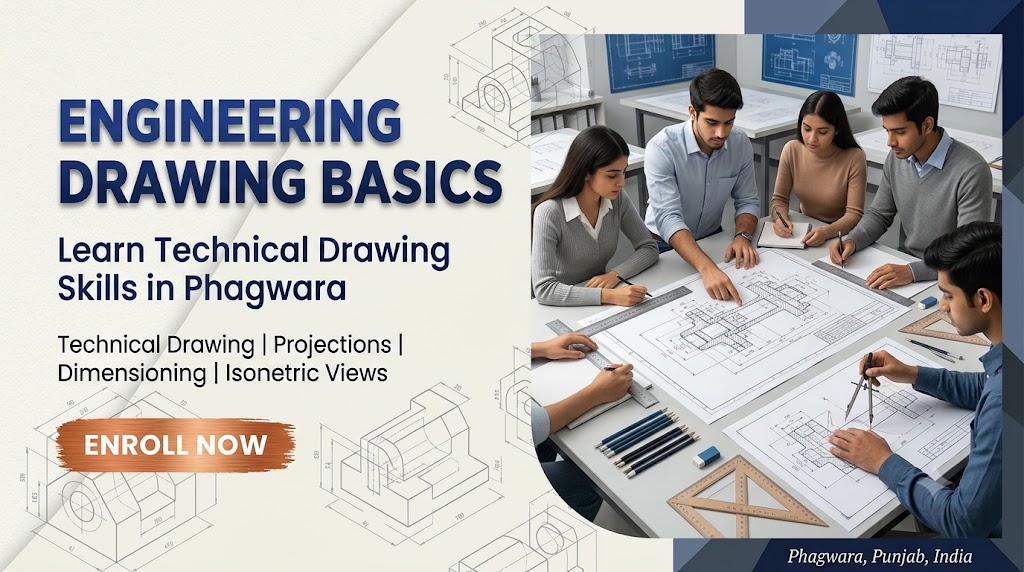
Introduction to Engineering Drawing
Understand the purpose of engineering drawings and how they are used in engineering, manufacturing, construction, and design.
Drawing Instruments and Their Uses
Learn about drawing boards, T-squares, set squares, scales, compasses, protractors, and other basic technical drawing tools.
Types of Lines in Engineering Drawing
Understand object lines, hidden lines, center lines, dimension lines, extension lines, and their correct applications.
Engineering Lettering and Numbering
Practice neat and standard lettering, numbering, and technical annotations used in engineering drawings.
Geometrical Construction
Learn to construct basic geometric shapes, angles, circles, arcs, polygons, and other figures using drawing instruments.
Scales and Measurements
Understand engineering scales, drawing measurements, and how to represent large or small objects accurately.
Dimensioning Techniques
Learn how to show lengths, widths, heights, diameters, radii, and angles using standard dimensioning methods.
Orthographic Projection
Understand front view, top view, and side view to represent three-dimensional objects through multiple two-dimensional views.
Isometric Drawing
Learn the basics of isometric representation and how to visualize three-dimensional objects on a two-dimensional surface.
Sectional Views and Drawing Practice
Understand basic sectional views and practice preparing technical drawings with proper lines, dimensions, and labels.