
Machine Learning Model Development
Build a complete ML project from scratch: prepare datasets, identify features, select an algorithm, train the model and evaluate predictions against real problem scenarios.
- Machine Learning
- Python
Learn AI from Python fundamentals to Machine Learning, Deep Learning, NLP and Generative AI — with live projects and placement assistance.
25,000+
Students trained
since 2007
4.9★
Google rating
556+ reviews
100%
Practical training
live client work
Techcadd’s Artificial Intelligence Programming Course in Phagwara is an industry-focused programme for students, graduates, job aspirants, entrepreneurs and aspiring freelancers who want practical skill in AI and modern programming. It covers Python, data analysis, Machine Learning, Deep Learning, Neural Networks, Natural Language Processing, Computer Vision, Generative AI, prompt engineering, APIs, automation and AI-powered application development. The training is hands-on throughout — live projects, practical assignments and industry-standard tools — so you learn to collect, prepare, analyse and use data while building models and applications that solve real problems. Unlike purely theoretical AI learning, you get exposure to real programming scenarios, machine learning workflows, model development and performance evaluation, and you finish understanding how businesses actually use AI to automate work, recognise patterns, generate content and make better decisions.

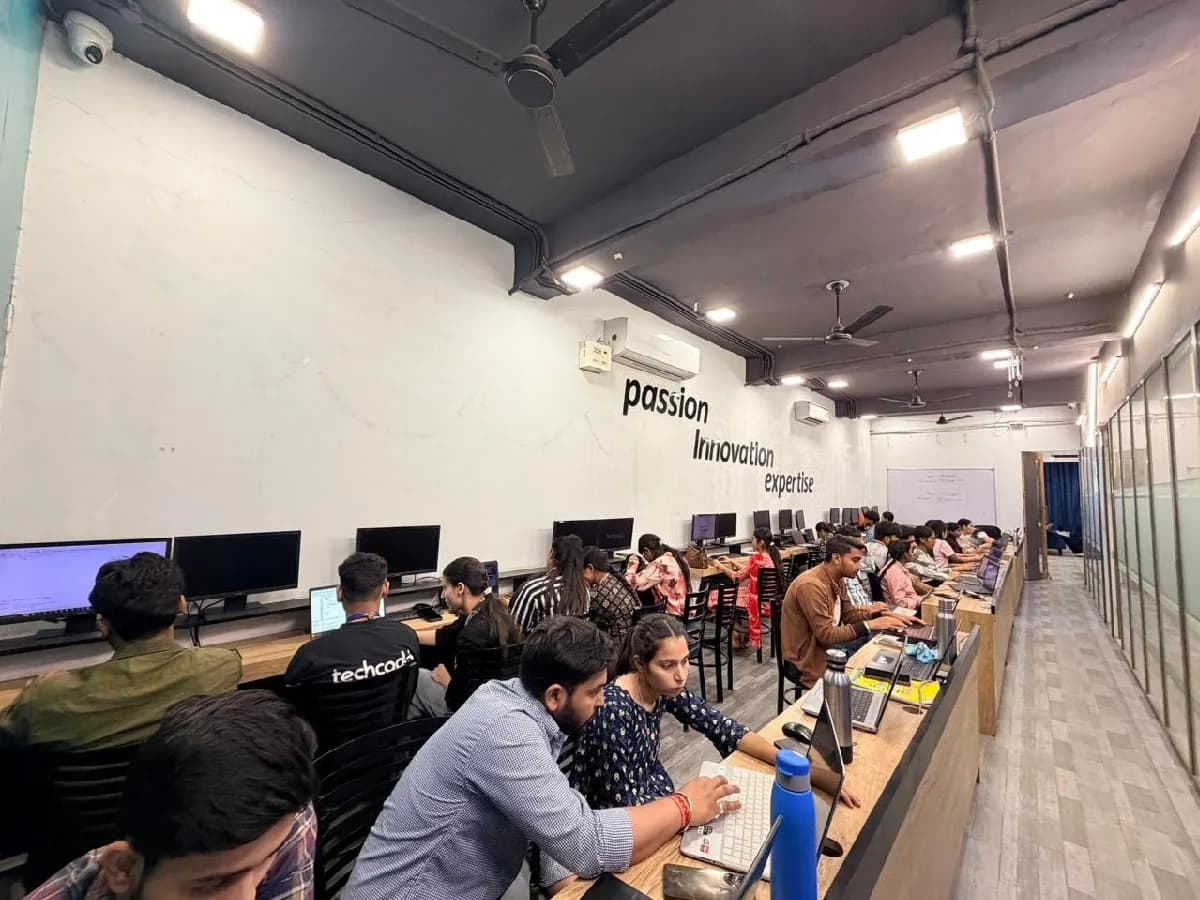
The Artificial Intelligence course is built for people at six different starting points, and the batch is deliberately mixed. What matters far more than your background is turning up consistently and finishing what each module asks you to build.
You do not need to understand advanced AI before learning the fundamentals. A structured course covers Python, problem solving, data handling, Machine Learning basics and practical workflows — a smart way to start exploring modern technology alongside your studies.
Employers value academic knowledge combined with practical technology skill. Whatever you study — computer science, engineering, mathematics, commerce, management or arts — AI shows you how intelligent systems use data and algorithms to solve hard problems.
Learning programming, mathematics, Machine Learning and AI tools alone is confusing. A structured path replaces tutorial-collecting with understanding how real projects work — preparing data, training models, testing predictions and building applications.
Already in IT, software development, data analysis, digital marketing or automation? AI makes your existing experience more valuable. Software professionals learn how AI features get built in; data professionals learn how models find patterns and generate predictions.
You do not have to become an AI engineer to benefit. Understanding how automation works, how AI tools process information and how customer data can be analysed makes you a better judge of technology decisions — and easier for developers to work with.
AI automation, Python work, Machine Learning projects, chatbot development, Generative AI applications, data analysis and API integration are all billable. The course teaches you to think like an AI developer, not just operate the tools.
Every sector hiring in Punjab now has an AI line in its budget, and the shortage is not people who can prompt a chatbot — it is people who can prepare data, train a model and tell you whether the result is any good. That gap is the whole argument for this course: there is local demand, there are budgets, and there are very few trained people to hand the work to.
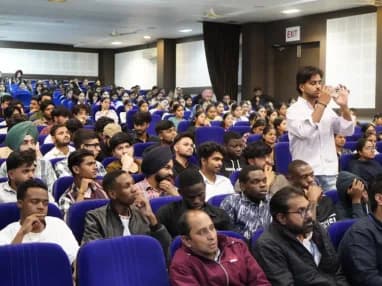
Build skills that hold up beyond the classroom.
What separates this from a playlist of tutorials is supervision on real work. From the second half of the course you build on live client projects with a trainer beside you, make decisions that have consequences, and correct them the following week. That loop is the skill. No employer in Phagwara will take your word for it without work they can inspect.
Be realistic about the money. A fresher who finishes with a working portfolio starts near the bottom of the band and moves quickly; someone who finishes with a certificate and nothing to show does not. The difference is entirely what you built.
The alternative is what most people try first: free videos, a cheap online course, six months of drifting, and knowledge you cannot demonstrate. A structured programme with live projects, a mentor who corrects you, an internship letter and a placement cell that actually calls employers is the difference between knowing the subject and being hired to do it.
Students reach the Phagwara centre from Banga, Nakodar, Kartarpur and the university belt, and the weekend batch exists so a job or a degree does not have to be paused to attend.
Healthcare, finance, e-commerce, education, IT, manufacturing, startups and digital businesses are all exploring AI to automate processes, analyse data and build smarter products. Python, ML, Deep Learning, NLP and Generative AI apply across all of them.
Using a tool is the beginning. Python fundamentals, data structures, OOP, data preparation and analysis, supervised and unsupervised learning, regression and classification, model training and testing, Neural Networks, NLP, Generative AI, APIs and evaluation.
Tutorials introduce concepts; practical training teaches you to solve problems. Hands-on work spans Python, data cleaning, ML models, prediction systems, chatbots, automation, visualisation, evaluation and Generative AI applications.
Generating an answer with AI is easy; building a useful solution is the challenge. You learn to evaluate data, select algorithms, train, test and improve — and to judge whether a solution is actually worth anything.
AI is changing how code gets written and how businesses automate. But tools do not replace understanding: problem framing, data quality, model limitations, accuracy, ethics and real-world requirements still need a person who knows what they are looking at.
The syllabus is arranged so every module produces an asset rather than a set of notes. You will cover ai foundations & python programming, data analysis & data preparation, machine learning & model development, artificial intelligence & predictive systems, and finish with a live project built on Python, Jupyter Notebook, Google Colab. Modules run in the order a real project runs: foundations first, then the core skills, then applied work under supervision, then the portfolio and interview preparation that turn all of it into an offer letter.
The working knowledge the job description actually lists.
Machine Learning & Model Development
Learn to build and train Machine Learning models, and to judge whether their predictions hold up.
4 weeks · 14 sessions
Artificial Intelligence & Predictive Systems
Build intelligent solutions that identify patterns and make predictions on real business scenarios.
3 weeks · 12 sessions
Deep Learning & Neural Networks
Learn how modern AI systems use Neural Networks to handle patterns simpler models cannot.
4 weeks · 14 sessions
Topics covered
The Artificial Intelligence course runs as three nested levels. Each one builds on the last, so you can start at the foundation and continue later without repeating anything.
Understand how AI works and how Python is used to build intelligent solutions — programming fundamentals, data handling and introductory Machine Learning.
What it covers
+ 2 more
Skills & tools
Recommended for
AI Trainee, Python Trainee, Data Intern and junior technology roles.
Build practical skill in data analysis, Machine Learning, model development, prediction systems and AI workflows — the level that makes you job-ready for technical roles.
What it covers
+ 4 more
Skills & tools
Recommended for
Junior AI Developer, Machine Learning Trainee, Python Developer, Data Analyst and AI Automation roles.
Combine Machine Learning with Deep Learning, Generative AI, NLP, AI APIs, automation and advanced application development.
What it covers
+ 6 more
Skills & tools
Recommended for
AI Developer, Machine Learning Engineer, Generative AI Specialist, AI Automation Specialist, Data Science Associate and advanced AI pathways.
Artificial Intelligence fundamentals
Python programming
Data structures & functions
Data analysis
Machine Learning basics
Regression & classification
Model training & evaluation
Data visualisation
AI APIs
Natural Language Processing
Deep Learning
Neural Networks
Generative AI
Large Language Models
AI automation
Advanced AI projects
Prompt engineering
The programme is nested, not parallel. The 3-month track gives you the essential foundation. The 6-month course includes those fundamentals and continues into professional data analysis, Machine Learning, model development and AI workflows. The 9-month programme combines all of it with Deep Learning, Neural Networks, NLP, Generative AI, AI APIs, automation and advanced portfolio projects — so moving to a longer duration never means starting from zero.
The toolchain behind the craft
Everything below is installed on the lab machines and used on live client work, not shown once in a slide and forgotten.
Complete the course with a portfolio of live projects and receive an industry-recognised certificate, plus a documented internship letter accepted by Punjab universities.
Recognised by employers across Punjab and beyond
Based on real client work, not a simulation
Live work you can show in any interview
CV review, mock interviews and hiring drives
Two certificates on completion — the course certificate and a separate capstone project certificate.
The roles this opens, what they pay in Punjab and beyond, and who is hiring for them — drawn from published job-market listings on one comparable scale, not a brochure number.
Salary outlook
Builds AI-powered applications, models and automation. Earnings vary with your skills, programming experience, portfolio, certifications, company, location and project capability.
Punjab — AI / Python
Delhi / NCR — AI / ML
Remote / Freelance AI Work
Indicative ranges for AI Developer roles, compiled from public job-market listings and drawn on the same scale in every market. Actual offers vary by employer, skillset and interview performance — Punjab pay typically reaches 2× the fresher ceiling within two years of delivery experience.
Talk about your target roleAI Developer, Machine Learning Engineer, Data Analyst, Python Developer, Generative AI Specialist, AI Automation Specialist and Deep Learning Associate. Practical project experience and problem-solving ability matter more here than certificates.
A fresher with real project work starts around ₹20,000 – ₹35,000 a month in the Punjab market, rising to ₹35,000 – ₹65,000 with two years of experience. Delhi/NCR runs materially higher, and specialists move well beyond it.
Yes, and AI freelancing has the widest ceiling of anything in the catalogue — ₹40,000 to over ₹1,00,000 a month once you have delivered real work. It starts lower, around ₹15,000 – ₹30,000, because freelance income ramps rather than starting at a salary.
IT companies building AI-powered software, startups building ML products, data-driven companies using AI for prediction and automation, e-commerce businesses running recommendation and analytics systems, and healthcare and finance organisations — plus remote and freelance clients.
Less than people fear. The course teaches the concepts you need as you meet them, and the practical work is programming and data handling rather than proofs. Comfort with school-level algebra and statistics is plenty to start; the depth comes later, if you specialise.
Build a complete ML project from scratch: prepare datasets, identify features, select an algorithm, train the model and evaluate predictions against real problem scenarios.
Build a prediction application that analyses data and produces useful outcomes, working through training, testing and performance evaluation.
Run a complete analysis project in Python: clean and organise datasets, find useful patterns, build visualisations and draw conclusions that hold.
Build a classification system that organises or identifies information from data patterns — training data, model, evaluation and how the algorithm reaches its answer.
Build an automation workflow with AI tools and programming, connecting models, APIs, prompts and a real business process.
Build an intelligent text-processing system: analyse language data, find text patterns and work through classification or generation workflows.
Build an intelligent application on Generative AI tools and APIs — prompts, responses, automation and practical workflows, with accuracy and responsible use kept central.
Build a complete AI solution for a real problem: identify it, prepare the data, develop and test the model, integrate it and present the finished work.
The working loop
Every project moves through the same loop: understand the brief, build with guidance, then explain the decisions behind your work.
Turn a real problem into a structured AI solution: research it, understand the data available, identify the variables that matter and choose an approach with measurable goals.
Problem Analysis & AI Project Brief
Develop with trainer guidance — Python, data preparation, ML algorithms, model training, AI APIs, Generative AI and automation — then improve on what the results actually show.
Machine Learning Model & AI Development
Present the problem, dataset, approach, results and technical decisions like a professional. Learn to name a solution’s limitations and explain your work convincingly.
End-to-End AI Project & Portfolio
There are many places to learn this in Phagwara and the brochure syllabus looks similar at all of them. What differs is who teaches, whether you ever touch real work, and whether anyone picks up the phone after you have paid. techcadd has trained students across Punjab since 2007 on the same model: small batches, working practitioners as trainers, client projects as coursework.
AI moves constantly — new ML techniques, Generative AI tools, platforms and workflows. Teaching uses current practice and practical examples, so you understand how intelligent systems work rather than only how to operate them.
Without practical work it is hard to see how data, programming and models fit together. Projects span Python, data analysis, ML, model training, prediction systems, Generative AI, NLP, automation and APIs.
A focused room means you can ask, discuss a difficult concept and get guidance mid-project — whether you are starting from scratch or strengthening existing programming skill.
Finishing should mean more than a certificate. Practical projects produce portfolio work demonstrating Python, data analysis, ML, Generative AI and automation — something real to discuss in an interview.
Resume improvement, interview preparation, portfolio presentation and mock interviews, with a realistic view of roles across AI development, ML, Data Science and automation.
The goal is confidence solving technology problems, not memorising algorithms or copying AI-generated code — practical Python, ML, data analysis, Deep Learning, Generative AI, automation and APIs.
What made it click for me was the lab time. You can sit after class and someone will still explain it until you get it.
I travelled in for the weekend batch and it was worth every trip. Small batch, real work, no time wasted on theory nobody uses.
The course got me interview-ready faster than I expected. My interviewer asked to see my project and that was the whole conversation.
I was switching careers and worried I would be behind. Half the batch was doing the same thing, and nobody made it awkward.
I joined with almost no background and finished with a project I could actually show. The trainer never rushed the basics.
techcadd’s placement cell kept calling me for drives until I was placed. That persistence mattered more than anything else.
Choosing a Artificial Intelligence course should be about more than a certificate. If the goal is a career, the things worth comparing are the coding practice, the projects, the trainer support and the skills you can actually apply.
AI curriculum
techcadd
Industry-focused training covering Python, Data Analysis, Machine Learning, Deep Learning, Generative AI, APIs and AI automation
Commonly offered
Often focuses mainly on basic AI concepts
Learning style
techcadd
Hands-on and practical, designed around real technology scenarios
Commonly offered
Can be more theory-oriented
Practical AI training
techcadd
Students learn data preparation, model development, testing, AI tools and application workflows
Commonly offered
Practical exposure may be limited
Machine Learning skills
techcadd
Covers algorithms, data processing, model training, testing and evaluation
Commonly offered
May cover only selected ML concepts
AI project development
techcadd
Focus on solving problems through practical AI projects
Commonly offered
Project exposure can vary
Data analysis
techcadd
Practical understanding of datasets, analysis, visualisation and model inputs
Commonly offered
Data preparation may receive limited attention
Portfolio building
techcadd
Practical assignments and AI projects that help students demonstrate their skills
Commonly offered
Portfolio development may receive less focus
Career support
techcadd
CV guidance, mock interviews, portfolio preparation and career-oriented support
Commonly offered
Career assistance can vary significantly
Doubt support
techcadd
Trainer guidance throughout to help clarify programming and AI concepts
Commonly offered
Support may be limited to scheduled sessions
Certification
techcadd
Course completion certification combined with practical learning exposure
Commonly offered
Certification format and practical exposure can vary
The right-hand column represents common market patterns, not a claim about any specific institute. Before choosing an AI institute in Phagwara, ask what you will actually learn, whether you will work on practical projects, how Machine Learning is taught, and what career support is included.
It is designed to help learners understand how AI systems use programming, data, algorithms and Machine Learning to solve problems. The focus is practical: Python, Data Analysis, Machine Learning, Deep Learning, Generative AI, NLP, AI automation, APIs and project development — real skills rather than theory.
One call with a counsellor is usually enough to find out. Book a free demo class and see the lab before you decide.

Send your question and a counsellor will call you back about batch timings, fees, EMI options, placement record, or whether this course fits your degree.